
The 14 Freeway between Palmdale and Los Angeles chews through cars. Sustained highway speeds, brutal grades through Vasquez Rocks and Acton, desert heat, and 60 to 100 miles per day of pounding turn a well-maintained vehicle into a repair bill fast. If you commute from Palmdale to Santa Clarita, the San Fernando Valley, or downtown LA, your maintenance schedule should not look like a regular driver’s. Here is what every Palmdale commuter needs to know.
Why the 14 Is Harder on Your Car Than City Driving
The 14 Freeway carries commuters through some of California’s toughest driving conditions.
The Acton grade: Southbound down through Acton drops nearly 1,500 feet in elevation across 15 miles. Your brakes work overtime holding the vehicle back. Northbound, your engine and transmission climb that same grade under load, sometimes in 105-degree heat.
Speed and load combined: Highway speeds of 70 to 80 miles per hour on the 14 for 40 or 50 miles each way mean your engine holds high RPMs for extended periods. Combined with the elevation change and desert heat, that stress compounds fast.
Stop-and-go bottlenecks: The Newhall Pass, the 5 interchange, and the sections through Santa Clarita often crawl at rush hour. Going from 80 mph to a dead stop repeatedly hammers brakes, transmissions, and cooling systems.
Weather swings: You leave Palmdale in 40-degree winter mornings and arrive in the Valley in 65-degree sun. In summer, you leave in 90-degree heat and hit the Sepulveda Basin at 78 with heavy smog. Your engine cycles through temperature ranges most cars never see.
Mileage adds up fast: Round trip from Palmdale to LA is 120 to 150 miles. Five days a week, that is 30,000 to 37,500 miles per year. A car that would last 12 years on 12,000 miles annually gets 4 to 5 years of that same mileage in a Palmdale commuter’s hands.
1. Change Oil Every 4,000 to 5,000 Miles (Not 7,500)
Manufacturer intervals of 7,500 miles apply to normal driving. Your commute is not normal driving. It qualifies as severe service under nearly every automaker’s definition.
Severe service conditions include:
- Extended highway driving in extreme temperatures
- Sustained high engine RPMs
- Frequent short trips within longer drives
- Dust and desert exposure
- Extreme temperature swings
If you drive the 14 five days a week, you check every box. Use full synthetic and plan for oil changes at 4,000 to 5,000 miles instead of stretching to 7,500. The math on oil life gets worse under sustained highway heat, not better.
2. Watch Your Brakes More Carefully Than Local Drivers
Descending the Acton grade daily wears brake pads and rotors 2 to 3 times faster than regular driving. A commuter who gets 50,000 miles from a set of brake pads under normal use often replaces them at 20,000 to 25,000 miles when the 14 is part of the routine.
Warning signs to watch for:
- Squealing or grinding on braking
- Vibration in the steering wheel when braking at highway speeds
- Longer stopping distances
- Brake pedal feels soft or spongy
- Brake warning light on the dash
- Burning smell after descending Acton
Downshift to hold speed on long descents instead of riding the brakes. Manual transmissions shift down. Automatic transmissions can use lower gears (usually 2 or 3) or the manual mode on newer vehicles. This transfers braking load to engine compression and saves your pads.
3. Keep Your Cooling System in Top Shape
The 14 climb from Newhall to Palmdale is one of the hardest workouts a cooling system faces. If your coolant is old, weak, or low, you find out on that climb in July at 105 degrees.
Coolant service checklist:
- Coolant exchange every 30,000 to 50,000 miles depending on vehicle
- Check the reservoir level monthly
- Watch for coolant leaks under the vehicle
- Inspect radiator hoses for cracking or soft spots
- Replace the thermostat if temperatures run high
Overheating on the 14 in July is not a repair. It is a rebuild. A blown head gasket from repeated overheat cycles costs $2,000 to $4,000. Regular coolant service costs $80 to $150.
4. Change Your Air Filter More Often Than the Manual Says
Manufacturer air filter intervals assume clean suburban driving. Your commute pulls dust off the desert floor, exhaust from the truck ahead, and construction debris from the constant 14 Freeway roadwork.
Standard interval: 15,000 to 30,000 miles
14 commuter interval: 10,000 to 15,000 miles
Check your air filter every oil change. If it looks gray, brown, or clogged, replace it. A dirty air filter cuts fuel economy 5 to 10 percent. On a Palmdale-to-LA commute, that adds up to real money over a year.
The cabin air filter matters too. It catches dust, pollen, and smog. Replace it every 12,000 to 15,000 miles or annually. If your AC feels weak or smells musty, the cabin filter is often the cause.
5. Rotate Tires Every Oil Change
Commuters wear tires unevenly because highway driving loads the front tires more than city driving. Front tires wear faster on the outside edges. Rear tires often wear evenly but slower.
Rotating tires every 5,000 miles balances the wear. Skipping rotation means replacing all four tires 15,000 to 20,000 miles sooner than necessary.
Tire signs to watch:
- Uneven wear patterns (inside, outside, or center)
- Tread below 4/32 (use a penny or a tread depth gauge)
- Vibration at highway speeds
- Pulling to one side
Alignment matters more for commuters too. Hitting a pothole on the 14 or the notorious stretches of Sierra Highway throws your alignment off. Get it checked annually or after any hard impact.
6. Do Not Ignore Small Warning Lights
Commuters often push through warning lights because they cannot afford to miss work. The 14 does not forgive that.
A check engine light that comes on during the drive down often means:
- Oxygen sensor failure (affects fuel economy immediately)
- Catalytic converter issue (repair bill grows if ignored)
- Small evaporative leak (cheap fix now, expensive fix later)
- Misfire (destroys catalytic converter if ignored)
Get warning lights checked immediately, especially before a long commute. Repair costs typically triple when small issues turn into major failures on the freeway.
7. Plan for Battery Replacement Every 3 to 4 Years
Palmdale summer heat kills batteries faster than moderate climates. A battery rated for 5 years in a coastal city often fails at 3 years in the Antelope Valley. Add in short cold-start cycles on winter mornings, and the lifespan drops further.
Have your battery tested annually starting at year 2. Free tests are available at most quick lubes including all three EZ Lube locations. A weak battery leaves you stranded at the wrong end of the 14 at the wrong time.
8. Bundle Services on Your Regular Oil Change Visits
Commuters do not have time to run around town for separate service appointments. Bundling saves time and often saves money.
Services to combine with an oil change:
- Tire rotation
- Air filter and cabin filter replacement
- Wiper blade replacement
- Coolant top-off or exchange
- Brake inspection
- Battery test
- Fluid checks
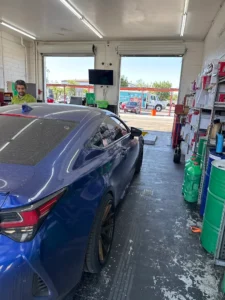
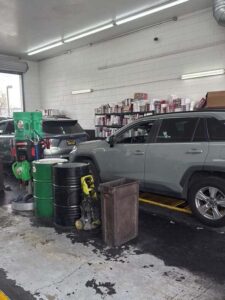
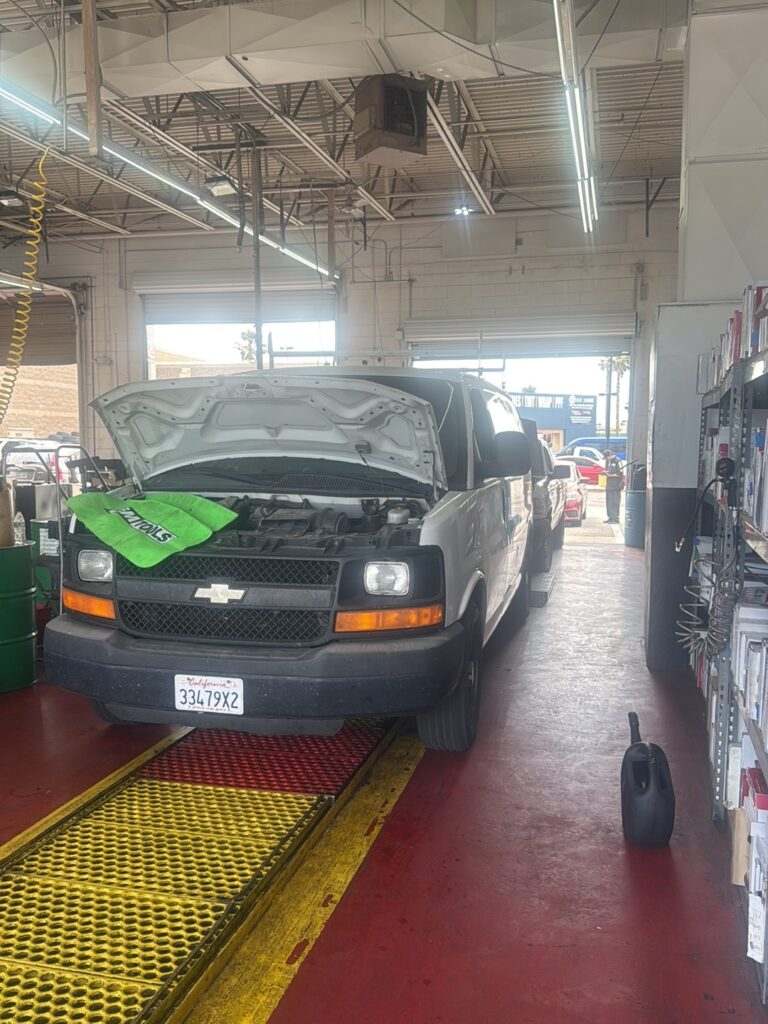
The Palmdale EZ Lube location at 320 W Rancho Vista Blvd, just off the 14 at the Rancho Vista exit, handles all of these in one drive-thru visit in about 15 to 30 minutes depending on services.
14 Freeway Commuter Maintenance Schedule
Here is a simplified schedule tailored to daily 14 Freeway commuters running Palmdale to LA and back.
Every:
4,000 to 5,000 miles:
- Full synthetic oil and filter change
- Tire rotation
- Multi-point inspection
10,000 to 15,000 miles:
- Engine air filter replacement
- Cabin air filter replacement
- Brake pad inspection (replace as needed)
20,000 to 30,000 miles:
- Wiper blade replacement (2 sets per year in dust conditions)
- Battery test
- Alignment check
30,000 to 50,000 miles:
- Coolant exchange
- Transmission fluid service
- Brake fluid exchange
Every 3 to 4 years:
- Battery replacement
- Serpentine belt inspection
Frequently Asked Questions
How much does daily 14 commuting shorten my car’s life?
A car driven 30,000 miles annually accumulates mileage 2.5 times faster than a 12,000-mile-per-year vehicle. Follow severe service intervals and your vehicle still runs strong at 200,000 miles. Skip the maintenance and expect major repairs by 100,000 miles.
What is the most important service for 14 commuters?
Oil changes at severe service intervals. Everything else compounds off engine health. A well-oiled engine tolerates almost every other maintenance mistake. A dry or contaminated engine fails no matter what else you do right.
Should I use synthetic or conventional oil for my commute?
Full synthetic. Conventional oil breaks down faster under sustained highway heat and cannot hold up to Antelope Valley summers combined with commute mileage.
How often should brake pads be replaced on a Palmdale commuter’s car?
Every 20,000 to 30,000 miles depending on driving style and vehicle. Riding the brakes down Acton shortens that further. Downshift to save pads.
Are dealership services required to maintain my warranty?
No. Federal law under the Magnuson-Moss Warranty Act protects your right to use independent shops for routine maintenance. Keep records of every service.
Do you service commuters early enough for a workday visit?
The Palmdale EZ Lube location opens at 7:30 AM weekdays. Drive-thru service takes 15 minutes. You get an oil change and still make it to work in the Valley by 9 AM.
Get Your Palmdale Commuter Vehicle Serviced
EZ Lube Oil Change at 320 W Rancho Vista Blvd, just off the 14 Freeway Rancho Vista exit, handles all commuter maintenance in one drive-thru visit. No appointment needed.
Address: 320 W Rancho Vista Blvd Unit B, Palmdale, CA 93551
Phone: 661-485-7192
Hours:
Monday through Friday: 7:30 AM to 7 PM
Saturday: 8 AM to 6 PM
Sunday: 8 AM to 5 PM
Check current oil change coupons before your visit. Serving Palmdale, Lancaster, Quartz Hill, Acton, and the entire 14 Freeway commuter corridor.